

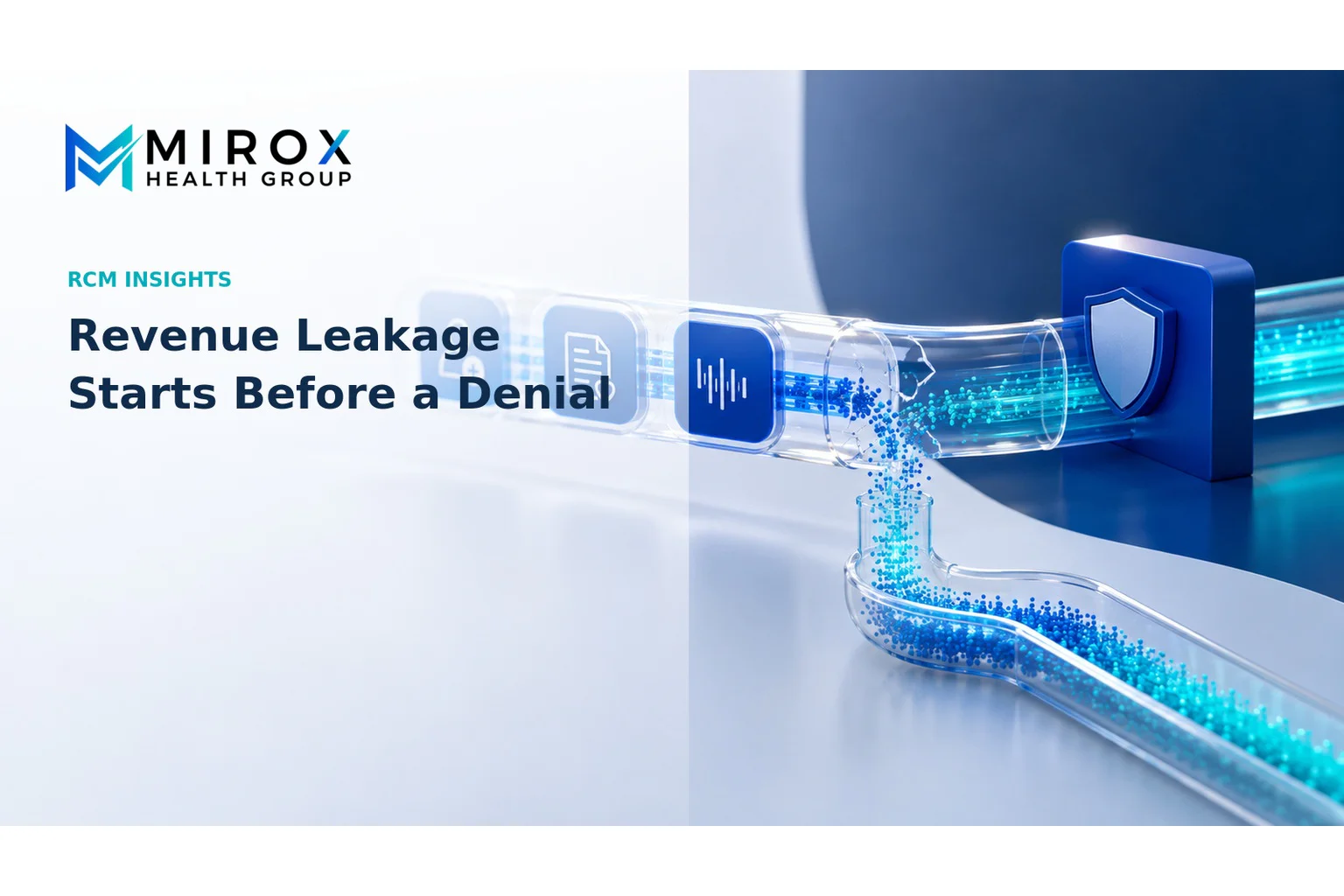
Revenue risk often enters the workflow before a claim is created. The strongest response is not more rework after a denial—it is earlier visibility, clearer ownership and disciplined control across the full revenue cycle.
Published: July 8, 2026 | Category: RCM Insights | Reading Time: 6 Minutes
A healthcare practice can maintain a full schedule, deliver excellent care and still leave reimbursement exposed. Patient access, authorization, documentation, charge capture, coding, claim preparation, payment posting and follow-up are operationally connected. When one stage passes incomplete or inaccurate information to the next, the financial consequence may not become visible until weeks later.
That is why a denial should be treated as evidence—not simply as an isolated billing event. It may point to an eligibility check that was not completed, an authorization requirement that was misunderstood, documentation that did not support the service billed, a claim edit that was missed or a payer response that was not acted on within the required timeframe.
“A denial is the visible event. The revenue risk often entered the workflow much earlier.”
— Mirox Health Group
Revenue Protection Begins Before Claim Submission
Effective denial management remains essential, but recovery work addresses a problem after it has already consumed time and delayed cash flow. A stronger operating model combines recovery with prevention: identifying where revenue becomes vulnerable, assigning ownership and correcting the source of recurring exceptions.
Before the Visit
Coverage, benefits, referrals, authorizations and patient information determine whether the financial pathway is ready before care is delivered.
Before the Claim
Documentation, charge capture, coding and claim edits determine whether the payer receives a complete, supportable submission.
Before the Deadline
Rejections, denials, requests for information, underpayments and aging balances require timely, accountable follow-up.
Where Revenue Becomes Vulnerable
Revenue leakage is rarely one failure in one department. It is more often the cumulative effect of small exceptions that move downstream without resolution.
| Revenue-Cycle Stage | Typical Exposure | Control Question |
|---|---|---|
| Patient Access | Incomplete demographics, inactive coverage, missing referrals or unclear patient responsibility. | Are exceptions identified and resolved before the encounter? |
| Authorization | Missing, expired or service-specific approvals; incomplete supporting documentation. | Can staff see ownership, status, validity dates and outstanding requirements? |
| Documentation & Coding | Documentation gaps, delayed charges, coding inconsistencies or unsupported modifiers. | Is claim readiness confirmed before submission? |
| Claim Control | Rejected claims, missing edits, duplicate work or delayed correction. | Are rejections separated from denials and routed immediately? |
| Payment & A/R | Unposted payments, contractual variance, underpayments, aging balances or missed appeal windows. | Does every material exception have a next action and accountable owner? |
The Difference Between Reporting and Operational Visibility
An A/R total describes the size of the inventory. It does not explain why balances remain open, which accounts require intervention or whether the same source problem is continuing to create new exposure.
Operational visibility connects a measure to a decision. Leadership should be able to move from a high-level trend to the payer, location, specialty, provider, procedure or workflow category that requires attention—and then see whether corrective action changed the pattern.
Lag and Readiness
Unbilled charges, documentation holds, claim-submission lag and unresolved front-end exceptions.
Denial Intelligence
Denial volume, root cause, payer concentration, appeal status and recurrence after corrective action.
A/R Priorities
Aging movement, high-value balances, payer delays, underpayment patterns and accounts approaching deadlines.
A Practical Revenue-Control Loop
- Detect the exception. Make incomplete, rejected, denied, underpaid and aging items visible at the point where action is still possible.
- Assign the next action. Define the owner, due date, escalation path and documentation needed to move the account forward.
- Resolve the account. Correct, resubmit, appeal, contact the payer or complete the appropriate patient follow-up.
- Trace the root cause. Determine whether the issue began in registration, eligibility, authorization, documentation, coding, claim preparation or payer processing.
- Correct the workflow. Update the checklist, edit, responsibility or training that can reduce recurrence.
- Verify the result. Monitor the affected trend to confirm that the intervention is working.
Questions Leadership Should Be Able to Answer
- Which revenue-cycle exceptions are increasing, and where do they originate?
- Which payers, services or workflows account for the most unresolved activity?
- How much work is waiting for documentation, correction, follow-up or escalation?
- Are teams resolving individual accounts without correcting repeatable root causes?
- Can leadership see whether prior interventions changed the underlying pattern?
The Mirox Perspective
Revenue-cycle performance improves when information moves with clear ownership. Patient-access teams need visibility into payer and authorization requirements. Billing teams need complete documentation and claim-ready information. Follow-up teams need defined priorities, accurate account histories and escalation paths. Leadership needs reporting that connects operational activity to the decisions required next.
The objective is not simply to work more accounts. It is to create a controlled revenue cycle in which preventable exceptions are identified earlier, unresolved balances receive focused action and recurring problems are corrected at their source.
Bring Greater Control to the Revenue Cycle
Discuss the workflows, reporting and follow-up priorities most relevant to your organization.
Frequently Asked Questions
What is revenue leakage in a medical practice?
Revenue leakage is reimbursement that is delayed, reduced, written off or missed because of gaps across patient access, authorization, documentation, coding, claim submission, payment posting, denial handling or account follow-up.
Is revenue leakage the same as a claim denial?
No. A denial is one visible outcome. Revenue may also become exposed through delayed charges, rejected claims, underpayments, unposted payments, missed filing or appeal deadlines and balances that do not receive timely follow-up.
Where should a practice begin?
Start with a focused review of front-end exceptions, claim-submission lag, rejection and denial root causes, A/R aging movement and payer-level variance. The purpose is to identify where work is waiting and which source problems recur.
Which metrics should leadership review?
Useful measures include claim-submission lag, first-pass or clean-claim performance, rejection and denial patterns, A/R aging, payer turnaround, underpayment variance and the status of high-priority accounts. Measures should be interpreted in the context of the practice’s payer mix, specialty and operating model.